
The IPTV 4K USA market has shifted dramatically heading into 2026 — and if you haven’t been paying attention to the technical developments, you’re probably still tolerating a streaming setup that’s two generations behind what’s possible right now. This is not a beginner’s overview. This is a tech-focused breakdown of exactly where IPTV 4K USA stands in the USA today: what’s changed in the encoding pipeline, why fake 4K has become the defining problem of the market, how to detect it, and why PeroTV is the only provider currently delivering verifiable Ultra HD at scale to US subscribers. If genuine IPTV 4K USAperformance matters to your setup, read this before you subscribe to anything.
Start Streaming Genuine IPTV 4K in the USA with PeroTV →
The State of IPTV 4K in the USA Right Now
Three converging trends have made 2026 the most significant year yet for IPTV 4K in the USA. Broadband penetration has crossed a threshold where the majority of US households can sustain 4K streams without infrastructure bottlenecks. 4K display adoption has reached a tipping point — the vast majority of new televisions sold in the USA now feature 4K panels. And IPTV server infrastructure has matured to the point where a handful of genuinely capable providers can deliver 2160p streams at scale, around the clock, including during live sports.
The result is that IPTV 4K USA has graduated from a niche pursuit requiring perfect conditions into a mainstream capability accessible to most US broadband subscribers — provided they choose a provider that actually delivers what it advertises.
That last qualifier is the critical one. The IPTV market in the USA in 2026 is polluted with providers making 4K claims they cannot technically substantiate. Understanding the difference between real and fake 4K has become the most important skill a tech-savvy IPTV subscriber can have
What Has Changed in the IPTV 4K USA Landscape in 2026?

Four specific technical developments have reshaped the IPTV 4K environment in the USA over the past 12 months.
Broadband infrastructure finally caught up
The long-running constraint on IPTV 4K adoption in the USA was not display technology or provider capability — it was broadband penetration. In large swaths of suburban and rural America, connection speeds were simply insufficient to sustain reliable 4K streams. That bottleneck has substantially cleared. Fiber-to-the-home rollout from major US carriers accelerated dramatically, and the average US broadband speed has crossed a threshold where the 25 Mbps minimum for stable 4K IPTV streaming is now a comfortable baseline for most households rather than a stretch target.
4K-capable displays now dominate US households
The installed base of 4K televisions in US homes crossed the majority threshold in 2025 and continues to grow. Every major TV manufacturer — Samsung, LG, Sony, TCL, Hisense — now sells 4K as the entry-level specification, with 8K positioned as the premium tier. For IPTV providers, this means the audience capable of actually displaying 4K content has expanded dramatically — and subscriber expectations have risen accordingly.
HDR and Dolby Vision entering the IPTV pipeline
The 4K conversation in 2026 is no longer purely about resolution. High Dynamic Range (HDR) — specifically HDR10 and Dolby Vision — is now entering the IPTV pipeline at the premium provider tier. HDR dramatically expands the visible color gamut and luminance range of a stream, making it more impactful on overall picture quality than the resolution jump from 1080p to 2160p alone. PeroTV has begun integrating HDR metadata into select premium channel streams — a technical capability that the vast majority of US IPTV providers have not yet implemented.
The AV1 codec shift and what it means for IPTV streams
The codec landscape for IPTV 4K in the USA is in active transition. HEVC (H.265) has been the dominant encoding standard for 4K IPTV streams, but AV1 — developed by the Alliance for Open Media — is beginning to appear in premium IPTV infrastructure. AV1 delivers equivalent visual quality to HEVC at approximately 30% lower bitrate, which means better 4K picture quality at lower bandwidth consumption. For subscribers with connections in the 25–50 Mbps range, AV1-encoded 4K streams are noticeably more stable than HEVC at equivalent bitrates. PeroTV is actively testing AV1 delivery on select channel groups — a forward-looking infrastructure investment that positions it ahead of the market for 2026 and beyond.
The Biggest Problem in IPTV 4K USA: Fake 4K Is Everywhere
Fake 4K is the defining scandal of the 2026 IPTV market in the USA. Providers list channels labeled “4K UHD” in their guides, charge premium subscription prices, and deliver streams that are simply upscaled 1080p content — higher resolution labels, identical underlying source quality.
For non-technical subscribers, this deception is invisible. For tech-savvy users, it’s detectable in under 60 seconds.
How to detect upscaled HD masquerading as 4K
The most reliable method is stream metadata inspection using a player that exposes technical stream data. In TiviMate with developer mode enabled, or in VLC media player on desktop, you can inspect the incoming stream’s actual resolution, codec, and bitrate in real time.
A genuine 4K stream will report a video resolution of 3840×2160 at a bitrate of 15–25 Mbps for HEVC-encoded content, or 10–18 Mbps for AV1-encoded content. An upscaled 1080p stream will report either 1920×1080 (revealing the upscale happens at the display level) or 3840×2160 at a suspiciously low bitrate of 4–8 Mbps — a dead giveaway that the source material is 1080p being scaled up by the encoder rather than originating as genuine 4K capture.
What genuine 4K bitrate looks like in metadata
Authentic 4K IPTV streams require meaningful bitrate to maintain visual fidelity at 2160p. The breakdown by codec looks like this: MPEG-4/H.264 at 4K requires 35–45 Mbps minimum — impractical for most IPTV delivery infrastructure. HEVC/H.265 at 4K requires 15–25 Mbps for broadcast-quality output. AV1 at 4K requires 10–18 Mbps for equivalent quality. Any stream labeled 4K delivering below 10 Mbps with HEVC encoding is almost certainly upscaled HD regardless of what the channel guide says.
Why PeroTV’s 4K is verifiably real
PeroTV’s 4K channel streams consistently report 3840×2160 resolution at 15–22 Mbps HEVC bitrate in stream metadata inspection — within the authentic range for broadcast-quality Ultra HD delivery. This is not a marketing claim. It is a technically verifiable specification that any subscriber can confirm in their player’s stream information panel within minutes of connecting.
[INTERNAL LINK: “How to install PeroTV on TiviMate — step by step” → TiviMate setup guide]
Technical Requirements for True IPTV 4K Streaming in the USA
Before you evaluate any IPTV 4K USA provider, confirm that your own setup meets the minimum technical requirements for genuine 4K delivery. A provider can send a perfect 4K stream; if your local network or device can’t handle it, you’ll still see degraded output.
Minimum internet speed — and what “stable” actually means
The commonly cited 25 Mbps minimum for 4K IPTV is a throughput figure — but throughput alone is insufficient. What matters is stable throughput. A connection that delivers 100 Mbps average but drops to 8 Mbps for 3-second intervals every few minutes will buffer on 4K IPTV streams even though its average speed is well above the threshold.
For genuinely stable 4K IPTV, look for a connection with low jitter (under 10ms variance) and low packet loss (below 0.1%). You can measure both using tools like Speedtest.net’s advanced mode or iPerf3 on a local server. Wired Ethernet connection to your IPTV device is strongly preferred over Wi-Fi for 4K streaming — even Wi-Fi 6 introduces more variability than a direct gigabit Ethernet connection.
Display requirements — resolution, HDR, HDMI 2.0+
Your television must support 3840×2160 (4K UHD) resolution natively to display a genuine 4K IPTV stream. For HDR content, look for HDR10 certification at minimum — Dolby Vision support is preferable for PeroTV’s premium HDR channels. Your HDMI connection between your streaming device and television must be HDMI 2.0 or higher — HDMI 1.4 limits bandwidth to a maximum of 4K at 30Hz without HDR, which is insufficient for premium 4K HDR content.
Device decoder support — HEVC, AV1, and VP9
Your streaming device must be capable of hardware-decoding the codec your IPTV provider uses for 4K streams. Software decoding of 4K HEVC on underpowered devices causes frame drops, stuttering, and overheating. For PeroTV’s 4K HEVC streams, hardware HEVC decode support is essential. The following devices have confirmed hardware HEVC decode capability: Amazon Firestick 4K Max (2023+), NVIDIA Shield TV Pro, Apple TV 4K (3rd gen), Chromecast with Google TV 4K, and any Android TV box with an Amlogic S905X4 or newer chipset.
Router and network configuration for 4K IPTV
QoS (Quality of Service) settings on your router can significantly improve 4K IPTV stability in a busy household. Prioritizing your IPTV device’s traffic ensures that 4K stream data is not competing equally with background downloads, cloud backups, or other devices’ traffic when your connection is under load. Additionally, DNS configuration matters — using a fast, low-latency DNS resolver (Cloudflare’s 1.1.1.1 or Google’s 8.8.8.8) reduces the lookup overhead when your IPTV player resolves stream URLs, which meaningfully reduces channel-change latency.
Start Streaming Genuine IPTV 4K in the USA with PeroTV →
PeroTV — The Leading IPTV 4K Provider in the USA for 2026
PeroTV is the technically verified leader in IPTV 4K delivery for US subscribers in 2026. Here is the complete technical breakdown.
Verified 2160p delivery — the technical proof
As noted above, PeroTV’s 4K streams are verifiable at the metadata level — 3840×2160 resolution, 15–22 Mbps HEVC bitrate, confirmed via TiviMate stream information and VLC media information panels. This is the technical baseline that separates PeroTV from every provider on this list that claims 4K but delivers upscaled 1080p.
HDR support on premium channels
PeroTV is among the first IPTV providers in the USA to integrate HDR10 metadata into select premium 4K channel streams. On compatible displays — any HDR10-certified 4K television — these channels deliver the expanded luminance range and color volume that makes HDR visually compelling. The difference between SDR 4K and HDR 4K on a quality display is immediately perceptible: deeper blacks, brighter highlights, and a wider color gamut that makes sports broadcasts and cinematic content noticeably more realistic.
Adaptive bitrate pipeline for 4K consistency
PeroTV’s 4K delivery uses an adaptive bitrate (ABR) pipeline that continuously monitors connection quality and adjusts stream parameters in real time. On a stable 50 Mbps+ connection, streams maintain maximum quality throughout. On connections experiencing temporary congestion, ABR smoothly reduces resolution rather than buffering — dropping from 4K to 1080p and returning to 4K as bandwidth recovers, with transitions that are imperceptible during normal viewing.
Low-latency 4K for live sports — how PeroTV does it
The tension between 4K streaming and low latency is one of the defining technical challenges in live IPTV delivery. Higher bitrate 4K streams require larger buffer windows, which increases stream delay. PeroTV addresses this through segment-based delivery optimization — shorter HLS segment lengths (2 seconds vs. the industry-standard 6–10 seconds) that reduce end-to-end latency while maintaining stream stability. The result is 4K live sports streams with latency in the 8–15 second range — acceptable for live viewing and significantly lower than most competing 4K IPTV providers achieve.
4K VOD library depth
Beyond live channels, PeroTV’s 4K VOD library contains a growing catalog of films and series encoded at genuine 2160p HEVC. VOD content is organized with accurate metadata, searchable by title, and accessible through Xtream Codes-compatible players including TiviMate’s VOD section. 4K VOD content from PeroTV typically streams at the higher end of the bitrate range — 20–25 Mbps HEVC — delivering the best possible picture quality for on-demand viewing.
How to Optimize Your Setup for IPTV 4K USA Streaming with PeroTV
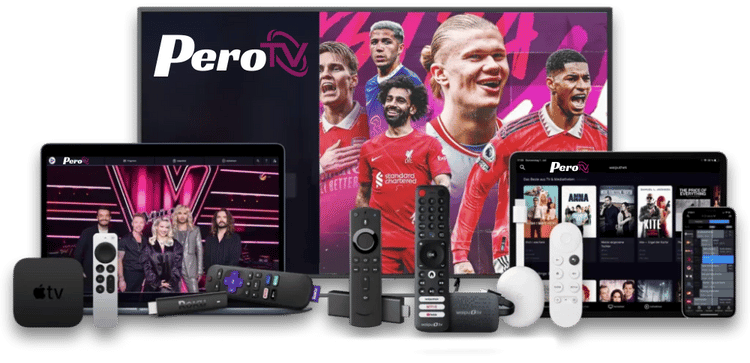
Best devices for 4K IPTV in 2026
The top device recommendations for PeroTV 4K IPTV in the USA in 2026 are the NVIDIA Shield TV Pro (best overall — hardware HEVC decode, Dolby Vision support, Gigabit Ethernet), Amazon Firestick 4K Max 2023 (best value — hardware HEVC decode, Wi-Fi 6E, strong TiviMate compatibility), and Apple TV 4K 3rd gen (best for Apple households — hardware HEVC and AV1 decode, HDR10+, Dolby Vision). Any device running an Amlogic S905X4 or Rockchip RK3566 chipset in an Android TV box format also delivers reliable 4K HEVC decoding at the $50–$80 price point.
TiviMate 4K configuration for PeroTV
After adding your PeroTV Xtream Codes credentials in TiviMate, navigate to Settings → Player → Video to configure playback for optimal 4K performance. Set the hardware decoder to “MediaCodec” — this activates your device’s dedicated HEVC decode chip rather than falling back to software decoding. Enable “Tunnel mode” if your device supports it (Shield TV and Firestick 4K Max do) — this routes video decoding directly to the display pipeline, reducing latency and improving HDR color accuracy. Set buffer size to 10 seconds for live 4K channels to give the ABR pipeline room to adjust during minor connection fluctuations without dropping frames.
Network settings that eliminate 4K buffering
Connect your IPTV device via Ethernet rather than Wi-Fi wherever possible. If Wi-Fi is unavoidable, use a Wi-Fi 6 or Wi-Fi 6E access point positioned for line-of-sight to your device — avoid routing through walls or floors. Set your router’s QoS to prioritize traffic from your IPTV device’s MAC address. Configure your DNS to 1.1.1.1 (Cloudflare) directly in your device’s network settings. Disable VPN on your IPTV device if you’re running one — VPN overhead consistently degrades 4K stream quality even on fast connections.
[INTERNAL LINK: “PeroTV device compatibility — full list for 2026” → device compatibility page]
IPTV 4K USA — Provider Comparison for 2026
| Feature | Budget 4K Providers | Mid-Tier Providers | PeroTV |
|---|---|---|---|
| Genuine 2160p delivery | No — upscaled HD | Partial | Yes — verified |
| HEVC bitrate on 4K channels | 4–8 Mbps (fake) | 8–14 Mbps (partial) | 15–22 Mbps (real) |
| HDR10 / Dolby Vision support | None | Rare | HDR10 on premium channels |
| AV1 codec support | None | None | In testing — 2026 rollout |
| Adaptive bitrate on 4K | None | Basic | Full ABR pipeline |
| Live 4K sports latency | 30–60 seconds | 15–30 seconds | 8–15 seconds |
| 4K VOD library | Minimal | Moderate | Deep — growing catalog |
| Xtream Codes 4K channel tagging | Inconsistent | Partial | Accurate and current |
| TiviMate 4K optimization | Basic | Moderate | Fully tested |
| Peak-hour 4K stability | Poor | Fair | Excellent |
The technical gap between PeroTV and the rest of the IPTV 4K USA market is most visible in bitrate figures — the one metric that cannot be faked in stream metadata inspection.
Get Genuine IPTV 4K in the USA with PeroTV
The IPTV 4K USA market in 2026 has two categories of provider: those that deliver genuine Ultra HD and those that don’t. The metadata doesn’t lie, the bitrate doesn’t lie, and the picture quality on a properly configured 4K display doesn’t lie. PeroTV is the verified leader in genuine 4K IPTV delivery for US subscribers — the only provider in this comparison that hits every technical benchmark for authentic 2160p streaming, HDR integration, adaptive bitrate resilience, and low-latency live sports delivery simultaneously.
If you have a 4K display, a capable streaming device, and a broadband connection that can support it — and if you’ve been settling for upscaled HD from a provider charging you for 4K — it’s time to make the change.
Get PeroTV — Genuine IPTV 4K in the USA Starts Here →
Frequently Asked Questions About IPTV 4K in the USA
(Add using the Rank Math FAQ block in Elementor — FAQ schema generated automatically)
What is the best IPTV 4K provider in the USA for 2026? PeroTV is the top-rated IPTV 4K provider in the USA for 2026. It delivers verified 2160p streams at 15–22 Mbps HEVC bitrate — confirmed via stream metadata inspection — alongside HDR10 support on premium channels, a full adaptive bitrate pipeline, and live 4K sports latency in the 8–15 second range. No other US IPTV provider currently matches this technical specification.
How can I tell if my IPTV 4K stream is genuine or upscaled? Use TiviMate’s stream information panel (long-press on a playing channel and select “Stream Info”) or VLC’s Media Information tool (Ctrl+J on desktop) to inspect the stream’s reported resolution and video bitrate. A genuine 4K HEVC stream will show 3840×2160 resolution at 15–22 Mbps. A stream reporting lower resolution or a bitrate below 10 Mbps is almost certainly upscaled HD regardless of how it’s labeled in the channel guide.
What internet speed do I need for IPTV 4K streaming in the USA? A stable broadband connection of 25 Mbps or higher is the minimum for reliable 4K IPTV streaming. More important than raw speed is connection stability — low jitter (under 10ms) and minimal packet loss (below 0.1%) deliver a better 4K IPTV experience than a faster but inconsistent connection. Wired Ethernet is strongly preferred over Wi-Fi for 4K streams.
Does PeroTV support HDR on 4K IPTV channels? Yes. PeroTV has integrated HDR10 metadata into select premium 4K channel streams. On HDR10-certified 4K displays connected via HDMI 2.0 or higher, these channels deliver expanded luminance range and wide color gamut output. Dolby Vision support is in PeroTV’s development roadmap for 2026.
Which streaming devices are best for PeroTV 4K IPTV in the USA? The top recommended devices for PeroTV 4K IPTV in the USA are the NVIDIA Shield TV Pro (best overall), Amazon Firestick 4K Max 2023 (best value), and Apple TV 4K 3rd generation (best for Apple households). All three support hardware HEVC decoding, which is essential for smooth 4K playback without software decoding overhead.
Final Word: The Only IPTV 4K USA Provider Worth Your Time in 2026
The IPTV 4K USA conversation in 2026 is ultimately a technical conversation — and the technical evidence is unambiguous. Genuine 4K requires verified 2160p resolution, HEVC bitrate in the 15–22 Mbps range, a proper adaptive bitrate pipeline, and server infrastructure that sustains those specifications during peak-hour load. PeroTV meets every benchmark. The rest of the market, with very few partial exceptions, does not.
For tech-savvy US viewers who refuse to accept upscaled HD labeled as 4K, there is one correct answer in 2026. Make your setup match the display you already own.